
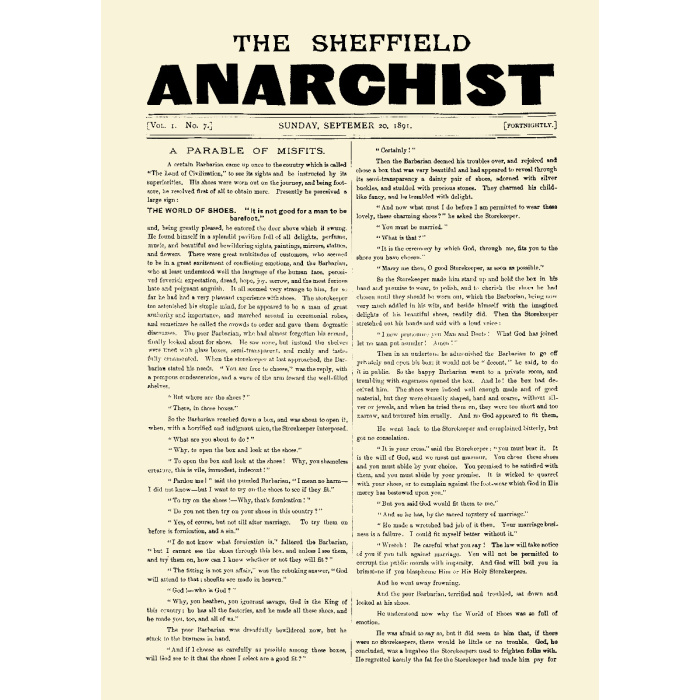
The Sheffield Anarchist September 1891
The Sheffield Anarchist, 20 September 1891
The Sheffield Anarchist was the first local anarchist paper in the UK.
The Sheffield Anarchist Group in the 1890s was a radical collective active in the industrial heartland of England, advocating for workers' rights, direct action, and the overthrow of capitalism. Influenced by international anarchist thinkers like Peter Kropotkin, the group engaged in propaganda, public meetings, and solidarity actions with striking workers, often clashing with the authorities.
Sheffield’s strong labour movement and harsh industrial conditions provided fertile ground for anarchist ideas, though the group remained relatively small compared to socialist organizations. Their activities reflected the broader late-19th-century anarchist wave, emphasizing decentralization, anti-statism, and revolutionary class struggle.
If you want to find out more about Sheffield Anarchists and other socialist and communist groups in Sheffield in the late 19th Century, you could get a copy of The Red Flag of Anarchy, published by Pirate Press.
Alongside the book, we have produced a poster - Radical Sheffield - which pinpoints the locations on a map from the Victorian era, where these revolutionaries, and many more, were active at the time.
-------------------------------------------------------------------
Anarchist ideas evolved over centuries, with elements traceable to the European Enlightenment, the English Revolution, and the French Revolution.
In the 19th century, anarchism significantly influenced early trade unions and workers' organizations.
Anarchists played a key role in the development of the International Workingmen’s Association (known as the First International). However, they clashed with Marx and his followers over the question of capturing state power and were eventually expelled. The history of the International and its successor organizations became closely tied to the development of Marx’s vision of communism and the concept of the dictatorship of the proletariat.
During this period anarchism became associated with the concept of “propaganda by deed” – taking actions that were intended to inspire others to take actions; and “mutual aid” – a belief that progress is best achieved through working together rather than competition.
Towards the end of the 19th century and into the first half of the 20th century, anarchists developed mass movements across the globe, particularly in Spain and other Spanish-speaking countries. In these regions, revolutionary trade unionism—or anarcho-syndicalism—took hold, emphasizing direct action to achieve goals rather than parliamentary representation.
Modern anarchism is more fragmented, but most anarchists still share a common opposition to capitalism and the state.
The Radical Poster Collective is dedicated to making good quality classic radical posters available at an affordable price.
Our posters are either digitally cleaned up to remove tears or stains etc, or completely recreated to be as close as possible to the original.
This is a digitally cleaned up copy of the front page of the original paper.
Printed on good quality 170gm poster paper.
The size is A3 (approximately 297mm by 420mm).
Please note that there may be some variation in the colour of the on-screen image and the actual item received. This is subject to the brightness and contrast of your screen settings etc.
All posters are dispatched securely in cardboard poster tubes to protect them.
Postage is only charged once for 1-4 posters (postage is free for 5 posters or more within the UK).
For non-UK orders, any customs duties are to be paid by the buyer.
| Product | Poster |
|---|