
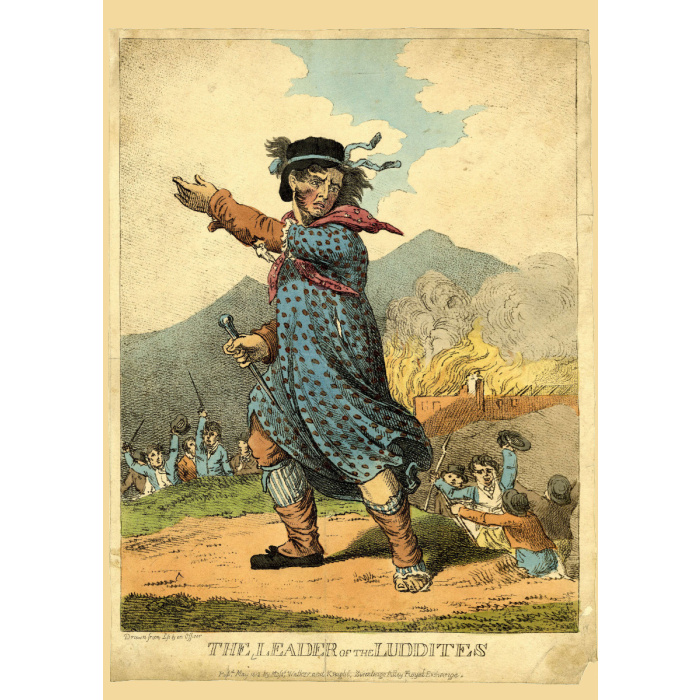
The Leader of the Luddites
The Leader of the Luddites, artist unknown, published by Walker and Knight, 1812
Organised sabotage of machines, and food riots happened periodically during the 18th Century in response to industrialisation and increasing capitalist exploitation.
Luddism was specifically a working-class movement in the early 19th Century, mainly in Lancashire and Yorkshire.
The Luddites were a secret organisation, opposed to technological advances that were used by factory owners to drive down costs and increase productivity, while reducing the workers ability to earn enough to survive. Luddites, incredibly well organised, were prepared to attack factories and break up the machines that were automating industrial processes.
The movement got its name from a legendary character, the weaver Ned Ludd who allegedly smashed two stocking frames in 1779. A proclamation was found in 1811 warning people against giving information about Luddites to the authorities:
"I do hereby discharge, all manner of Persons, who has been, employ’d by me, in giveing any information, of breaking Frames, to the Town Clerk, or to the Corporation Silley Committee ~ any Person found out, in so doing or attempting to give any information, will be Punish’d with death, or any Constable found out making any enquiries, so has to hurt the Cause of Ned, or any of his army, Death (by order of King Lud)."
The Government used legal and military force - 12,000 troops were used and machine breaking was made into a capital offence. Executions and transportations suppressed the movement.
-------------------------------------------------------------------
Radical posters before the 20th century were predominantly text-based, primarily used to advertise events, meetings, and demonstrations rather than relying on colourful graphic imagery to convey ideas. While some did incorporate sketches or cartoons, these were relatively modest compared to the bold visual styles that emerged later.
Although the technology for producing striking graphics existed at the time and was widely used in commercial advertising, such vivid and imaginative designs were less common in political posters. It wasn’t until later that the kind of dynamic, visually arresting imagery often associated with the Russian and Spanish Revolutions blossomed in radical posters.
The posters in our pre-20th century selection reflect this earlier approach – they focus squarely on delivering a direct message, often employing dramatic language and typography to capture attention and provoke thought.
The Radical Poster Collective is dedicated to making good quality classic radical posters available at an affordable price.
Our posters are either digitally cleaned up to remove tears or stains etc, or completely recreated to be as close as possible to the original.
We don't have printed copies of this poster. It's just exhibited on our website.
| Product | Poster |
|---|