
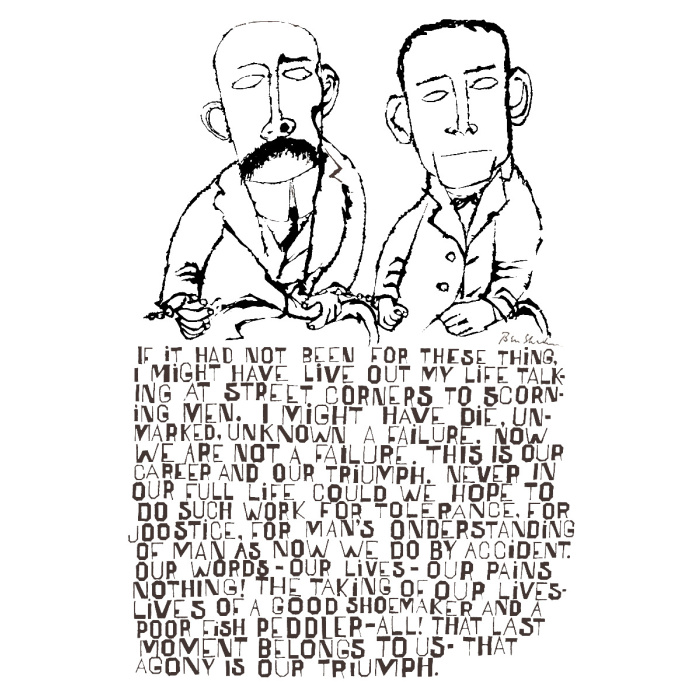
Sacco and Vanzetti - That Agony is Our Triumph
Sacco and Vanzetti - That Agony is Our Triumph Ben Shahn, 1958
Ben Shahn has made lots of posters highlighting social injustice; including Organise? Of Course We Will Organise.
------------------------------------------------------------------
Nicola Sacco and Bartolomeo Vanzetti were two Italian American anarchists accused of carrying out an armed robbery in Braintree Massachusetts in 1920 where two people were killed by the robbers. Their trial is widely considered to have been deeply flawed, and they were murdered by the Commonwealth of Massachusetts on 23 August 1927.
The quote is from Vanzetti, published in the New York World in May 1927, immediately after their final appeal had been rejected.
Violent demonstrations swept through many cities the day after the execution, including Geneva, London, Paris, Amsterdam, and Tokyo. In South America wildcat strikes closed factories. Three died in Germany, and protesters in Johannesburg burned an American flag outside the American embassy.
At the funeral home, more than 10,000 mourners viewed Sacco and Vanzetti in open caskets with a wreath over the caskets announced: In attesa l'ora della vendetta (Awaiting the hour of vengeance).
On Sunday, August 28, a two-hour funeral procession bearing huge floral tributes moved through Boston. Thousands of marchers took part in the procession, and over 200,000 came out to watch. Police blocked the route, which passed the State House, and at one point mourners and the police clashed. The Boston Globe called it "one of the most tremendous funerals of modern times" but all film of the funeral procession was ordered to be destroyed.
In 1977, fifty years after their execution, Massachusetts Governor Michael Dukakis issued a proclamation stating that Sacco and Vanzetti had been unfairly tried and convicted and that "any disgrace should be forever removed from their names."
-------------------------------------------------------------------
Anarchist ideas evolved over centuries, with elements traceable to the European Enlightenment, the English Revolution, and the French Revolution.
In the 19th century, anarchism significantly influenced early trade unions and workers' organizations.
Anarchists played a key role in the development of the International Workingmen’s Association (known as the First International). However, they clashed with Marx and his followers over the question of capturing state power and were eventually expelled. The history of the International and its successor organizations became closely tied to the development of Marx’s vision of communism and the concept of the dictatorship of the proletariat.
During this period anarchism became associated with the concept of “propaganda by deed” – taking actions that were intended to inspire others to take actions; and “mutual aid” – a belief that progress is best achieved through working together rather than competition.
Towards the end of the 19th century and into the first half of the 20th century, anarchists developed mass movements across the globe, particularly in Spain and other Spanish-speaking countries. In these regions, revolutionary trade unionism—or anarcho-syndicalism—took hold, emphasizing direct action to achieve goals rather than parliamentary representation.
Modern anarchism is more fragmented, but most anarchists still share a common opposition to capitalism and the state.
The Radical Poster Collective is dedicated to making good quality classic radical posters available at an affordable price.
Our posters are either digitally cleaned up to remove tears or stains etc, or completely recreated to be as close as possible to the original.
We do not have printed copies of this poster. It is just exhibited on our website.
| Product | Poster |
|---|