
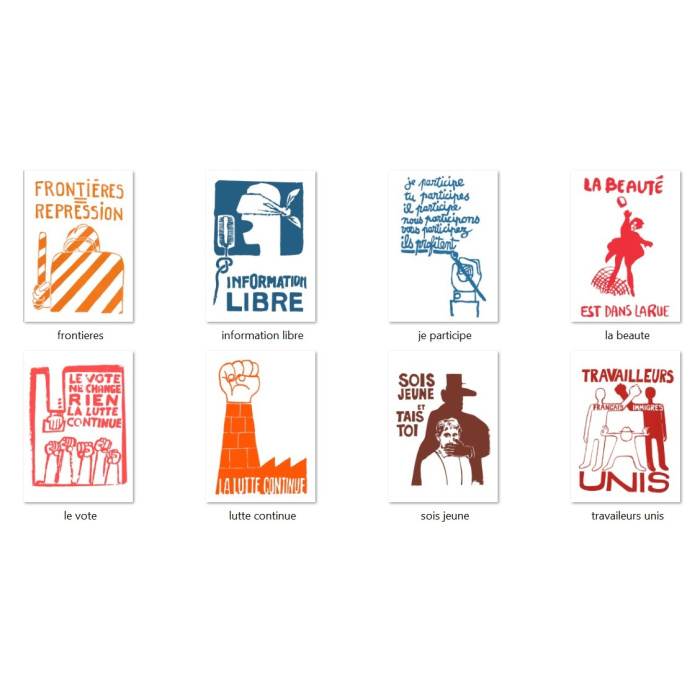
Paris 1968 Postcard Set
May 1968 Worker and Student Uprisings in Paris, various designs from Atelier Populaire (Popular Workshop)
The Atelier Populaire (People’s Workshop) was established on 14 May when a group of art students occupied the Ecole des Beaux Arts (School of Fine Arts) and decided to use their skills to create posters in support of the uprising. They agreed to maintain anonymity – as a rejection of the bourgeois cult of the artist and to reinforce the idea that art served the purpose of the revolution not the personal fame of the artists or the art market.
The first posters were lithographs – which is quite a time-consuming process, but a couple of silk screen printers lent them their equipment and taught them how to use it: how to cut stencils, use photography in the process, and clean the screens after use. They were soon able to knock out 2,000 posters a day.
Paper and inks came from striking newspapers and print shops. Posters were put up at night by Action Committees and distributed to striking workers to share on the pickets and in the occupied factories.
Workers and students came to the Atelier with ideas for poster designs and they would be discussed in the context of the day’s events in a General Assembly. Decisions were made based on their political value rather than aesthetic: was the political idea correct; and did the design communicate the idea well.
The Atelier was raided by the police on 27 June, but the artists were able to just walk out peacefully, carrying their equipment. For a while they continued creating posters. In the immediate aftermath of the raid, they produced a poster with the words: “La Police s’affiche aux Beaux Arts, Les Beaux Arts affichent dans la rue” (The police post themselves at the School of Fine Arts, the Fine Arts students poster the streets)..
-------------------------------------------------------------------
Originating as student protests and occupations against capitalism, the May 1968 unrest grew into a mass movement and general strikes - including both official trade union strikes and wildcat actions - in reaction to police repression. Barricades were erected and police assaults were countered with bricks and paving stones.
President De Gaulle fled to West Germany, fearing an imminent revolution.
The Government made a deal with the trade unions, increasing the minimum wage by 35% and increasing pay by 10%, better protection and a shorter working day, but the rank and file rejected it.
The National Assembly was closed down and a General Election was called, which De Gaulle won massively. The uprising tailed off.
The uprising inspired an explosion of revolutionary graffiti, inspired by Situationism (for example: "be realistic, demand the impossible") and poster art. Mass produced simple one colour screen prints became symbolic of the uprising.
The Radical Poster Collective is dedicated to making good quality classic radical posters available at an affordable price.
The images on our postcards are either digitally cleaned up to remove tears or stains etc, or completely recreated to be as close as possible to the original.
There are eight designs in each set. The postcards are A6 size (approximately 105mm by 149mm), printed on 350gm postcard card.
Please note that there may be some variation in the colour of the on-screen image and the actual item received. This is subject to the brightness and contrast of your screen settings etc.
For non-UK orders, any customs duties are to be paid by the buyer.
| Product | Postcards |
|---|