
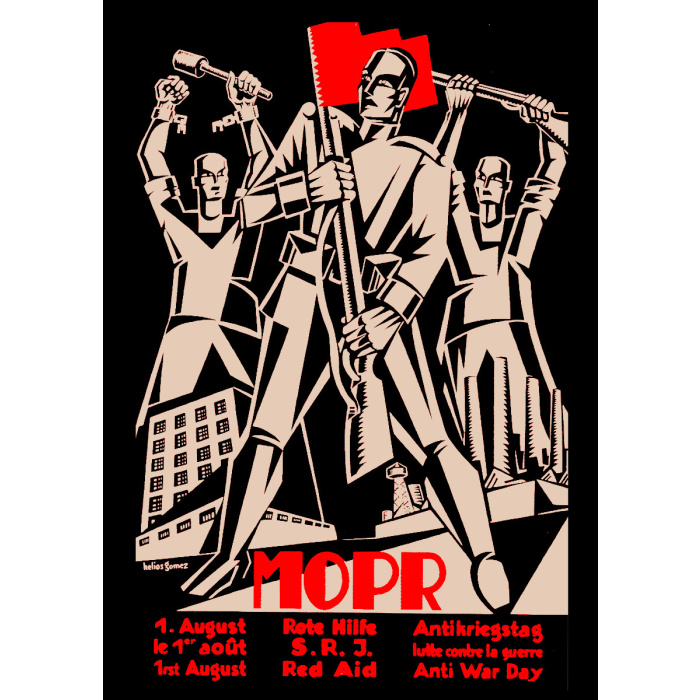
MOPR - International Red Aid - 1 August, Anti-War Day
MOPR - International Red Aid - 1 August, Anti-War Day - by Helios Gomez
International Red Aid (International Organization for Aid to Revolutionaries), was established by the Comintern in 1922 to provide moral and material support to revolutionary class war prisoners. By the late 1920s it claimed nearly 9 million members in countries across the world (though most members were in the Soviet Union).
-------------------------------------------------------------------
Helios Gómez Rodríguez was born in the Roma community in Seville in 1905. He became a trade unionist, avant garde painter, poster artist and poet. He joined the CNT in 1923 and was forced to go into exile to Paris in 1927. He was expelled from France for participating in demonstrations against the executions of Sacco and Vanzetti.
In 1930 he returned to Spain and joined the Communist Party (PCE). He served on several fronts during the Civil War and was a political commissar.
He fell out with the PCE and rejoined the CNT, where was made responsible for producing the newspaper of the Durruti Column - El Frente. After the war he continued the fight, spending three years in concentration camps in France and Algeria. He escaped and returned to Spain in 1942 where he helped to found Liberación Nacional Republicana (Republican National Liberation), a clandestine resistance organisation.
He continued to fight against discrimination, injustice and stereotyping of the Roma community.
He was imprisoned again in 1946 and released in 1954. He died in 1956 from a liver disease he had contracted in prison.
-------------------------------------------------------------------
In 1917, after three years of devastating war, food shortages and government corruption, the workers and peasants of Russia rose up to overthrow the ruling elite and attempted to create the world’s first communist society under the slogan “All Power to the Soviets”.
Throughout the year there were riots, mutinies and strikes, influenced by and involving Mensheviks, Anarchists, Social Revolutionaries and Bolsheviks.
By October, the Bolsheviks, who promised to end Russia’s involvement in the war, were able to overthrow the provisional government, which had been established after the abdication of the Tsar in February.
As the Bolsheviks centralised power and tightened their control over the new state, civil war broke out across Russia as monarchists and liberals (known as the Whites), supported by Western capitalist democracies, fought back against the Bolsheviks.
At the same time, various non-Russian independence movements, anarchists and anti-Bolshevik socialist parties rebelled against Bolshevik imposed terror.
By 1923 the Bolsheviks had defeated the White Army and suppressed internal dissent. The Civil War concluded with a Bolshevik victory.
Before the Revolution and throughout the period of the existence of the Soviet Union, visual propaganda was considered a significant means to inform, educate and motivate people.
The Radical Poster Collective is dedicated to making good quality classic radical posters available at an affordable price.
Our posters are either digitally cleaned up to remove tears or stains etc, or completely recreated to be as close as possible to the original.
We do not have printed copies of this poster. It is just exhibited on our website.
| Product | Poster |
|---|