
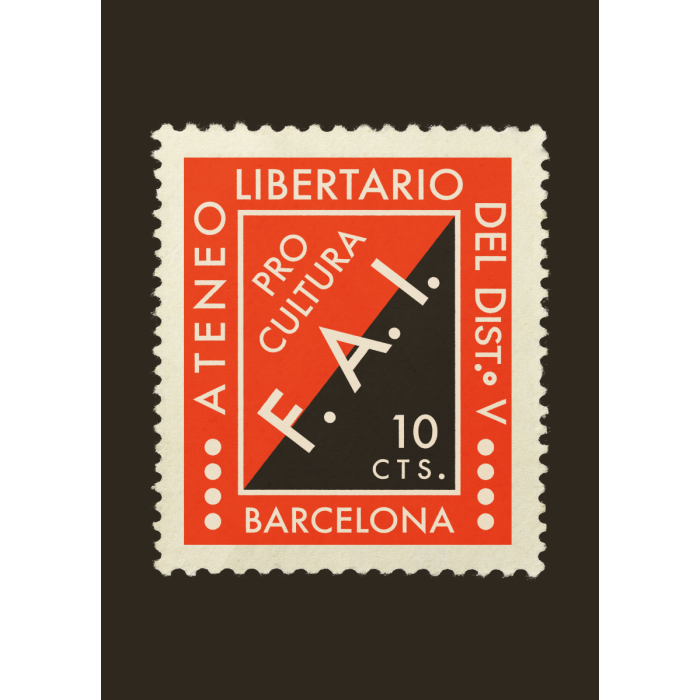
Ateneo Libertario FAI Stamp
Ateneo Libertario FAI Stamp - reproduction of a postage stamp at A3 poster size.
The Ateneos Libertarios were cultural and educational centres that played a significant role in the Spanish anarchist movement following their emergence in the late 19th century. Their development was closely linked to the anarcho-syndicalist movement, with figures such as Anselmo Lorenzo advocating for their establishment within local labour unions. By the time of the Second Spanish Republic (1931–1939), these centres had become widespread, serving as hubs for worker education, cultural activities, and political organization.
Building on the anarchist conviction that knowledge and critical thinking were essential for both individual and collective liberation, the centres offered a diverse range of educational programs and training to support personal and community development. Literacy and basic education, along with courses on anarchism and syndicalism, provided opportunities for those who lacked formal schooling, while workshops on contraception, nutrition, and public health aimed to improve overall well-being. Practical training in mechanics, engineering, and cooperative work encouraged both independence and collective organisation. In addition to these educational initiatives, the Ateneos Libertarios maintained extensive libraries containing anarchist literature, newspapers, and pamphlets, serving as vital repositories of political and historical knowledge for those without ready access to such information.
Artistic and cultural activities were integral to the dissemination of anarchist ideals and the reinforcement of communal bonds. Theatrical performances, poetry and literary readings, music, and visual arts exhibitions were regularly held, alongside public debates and guest lectures. Outdoor activities such as hiking and nature retreats promoted self-sufficiency, self-care, and communal living.
The principle of mutual aid was central to anarchist activity, and the Ateneos Libertarios played a crucial role in supporting workers and their families. They organized fundraising efforts for striking workers and political prisoners, planned protests and direct actions, and operated community kitchens to assist impoverished workers and their families. Legal aid services and the establishment of workers' cooperatives further strengthened grassroots resilience within the community.
During the Spanish Revolution, the Ateneos Libertarios functioned as centres for political mobilisation against fascist forces. Printing presses produced posters, newspapers, and pamphlets to inspire and educate, while basic military training was provided to militia members fighting in anarchist brigades. Social support networks also assisted families affected by the war.
These centres were deeply embedded in the anarchist movement, particularly within the Confederación Nacional del Trabajo (CNT) and Federación Anarquista Ibérica (FAI), playing a crucial role in sustaining revolutionary ideals during the war. Their legacy continues to inspire revolutionary groups and movements to this day.
-------------------------------------------------------------------
The CNT was founded in November 1910, with a membership of 26,000 at a conference of workers societies in Barcelona and had its first national congress the following year. A general strike was immediately called in Barcelona and the CNT was declared illegal.
By 1919 there were 700,000 members. As the CNT grew, employers became more worried and hired armed thugs (pistoleros) to intimidate or assassinate union members.
The CNT took part in revolutionary strikes and uprisings throughout the period leading up to the 1936 Revolution and Civil War, including uprisings in Catalonia, Asturias and Andalusia. By 1937 the CNT had 1.5 million members.
From the start of the attempted coup in 1936, the CNT had a decisive role in events - pushing revolutionary land and factory collectivisation, but by May 1937 the Republican Government, under the influence of the Stalinist Spanish Communist Party (PCE), was reversing its achievements, suppressing the collectives, forcing militias to join the regular army or be disbanded and arresting militants.
The Radical Poster Collective is dedicated to making good quality classic radical posters available at an affordable price.
Our posters are either digitally cleaned up to remove tears or stains etc, or completely recreated to be as close as possible to the original.
This is a recreation of an official postage stamp used during the Revolution and Civil War.
Printed on good quality 170gm poster paper.
The size is A3 (approximately 297mm by 420mm).
Please note that there may be some variation in the colour of the on-screen image and the actual item received. This is subject to the brightness and contrast of your screen settings etc.
All posters are dispatched securely in cardboard poster tubes to protect them.
Postage is only charged once for 1-4 posters (postage is free for 5 posters or more within the UK).
For non-UK orders, any customs duties are to be paid by the buyer.
| Product | Poster |
|---|